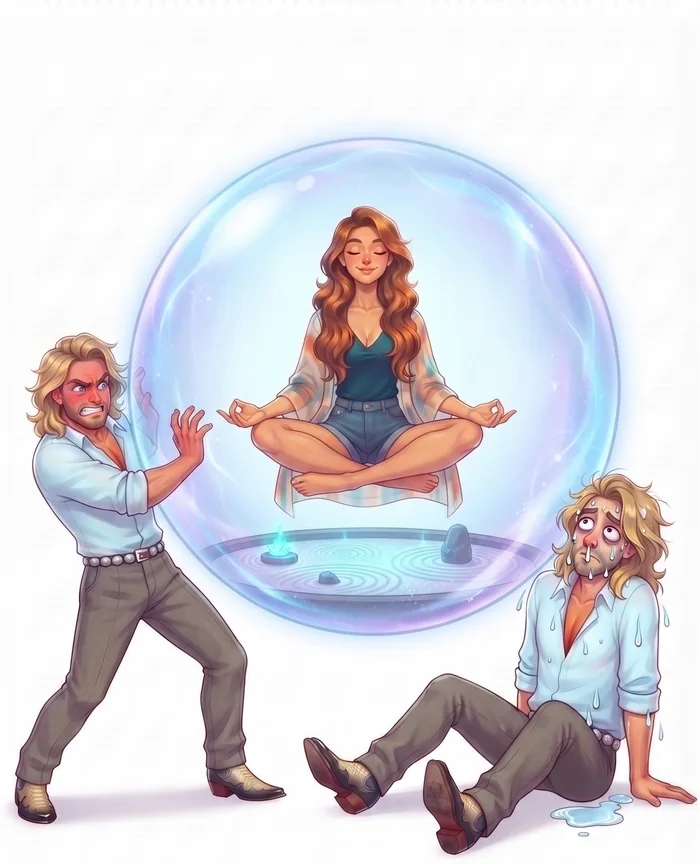

How do you decide without giving in to pressure?
Take back your space and your time
Even if you’re pushed to answer right away, you’re always the one who chooses: whether you answer or not, when, and how. Or whether you put it off.
The net closes in
It’s New Year’s Eve.
— One of them raises his voice.
— The other calls on you as a witness.
— You’re pushed to take sides. “Pick your side, or you’ll regret it.”
— And you? You’re stuck. You can’t leave, it would cause a scene. You can’t stay, you won’t last 20 minutes. So you keep quiet, you smile, and you wait for it to pass. Result: you vanish from your own evening.
Or else…
Comeback
— “I don’t decide under threat.”
After all, you’re the one who decides. Stand your ground, in your own place.
Extract from chapter 16 — The Chestnut-Stuffed Turkey
And if you don’t manage it first time? You need 2 minutes.
Shift your attention to your body
You don’t change other people. You change yourself.
Your body is on alert, and no words come out. Notice, and relax as you go.
You’ve stopped breathing — start again.
Your shoulders are up by your ears — let them drop.
You’re slumped in your chair, or perched on the edge — take your place back.
As long as your body is on alert, your head looks for the exit instead of deciding what to do in your own interest.
Come back into your body: four moves, and your head follows
- Put the whole soles of your feet on the floor. Or go for a walk. Incredibly effective.
- Steer your breath. Breathe a thin stream of air in and out, slowly. The longer, the better.
- Create your bubble around you. Take back your space.
- Speak up. You’ve got something to say, say it. Your sentence: “I’m not deciding tonight. I’ll do it later, with a clear head.” Take back your time.
If you’re afraid of forgetting it, rehearse it in advance, so you can bring it out when you need it.
⚠ This isn’t about taking everything on the chin
Still less about staying for ever in a room where you’re being mistreated.
If you have to do it every 10 minutes all evening, the real answer isn’t the exercise: it’s the door.
What it changes
You stop swinging between exploding and disappearing. 2 minutes to step back, and choose what you do next: answer, keep quiet, or leave. You choose, not the atmosphere.
Remember
One good comeback is worth a thousand silences.
Take back your space and your time: that’s where you decide.
Practical guide 02 — Take back your space and your time
“My pen is my NO.”
The novel The Hammock and the Hummingbirds, by Karine Baridon.
 Guide 01 — Say no without negotiating